Why MedTech teams need “Events” before CAPA, and why a Quality Event System (QES) is not a task list
In the old world, it works like this:
An engineer emails you: “I noticed something off during testing.”
You reply: “Thanks—please track it.”
A task gets created.
The conversation moves on.
Three weeks later, a question appears during an internal audit:
“Where is the documented evaluation of that observation?”
And suddenly you realize the uncomfortable truth:
A task is not a record.
And an email thread is not objective evidence.
This is how “missing data” happens in MedTech quality systems—quietly, repeatedly, and usually with the same result: audit anxiety.
The real problem isn’t lack of effort. It’s “data leakage.”
Most quality-critical signals don’t start as CAPA, NCR, or complaint forms.
They start as:
- a comment in Teams/Slack
- a quick note on paper
- a sentence in a meeting
- a field engineer’s observation
- a minor deviation during verification testing
Quality Managers live with this every day: quality exists in the real world first, and enters the QMS later—if at all.
That gap creates what many teams unknowingly operate: a Shadow QMS
(informal channels where quality decisions happen, but documentation doesn’t).
If it isn’t documented, it legally doesn’t exist
Under ISO 13485 and FDA expectations, it’s not enough to say:
“We noticed it and handled it.”
You need to show:
- what was observed
- who evaluated it
- what decision was made
- why that decision was appropriate
- what happened next
That is the difference between “we think we’re compliant” and “we can prove it.”
Why a task list can’t solve this
A task is designed to drive execution.
But it rarely captures the compliance story:
- the original signal
- the evaluation rationale
- the escalation decision
- traceable closure
That’s why quality teams end up doing “documentation archaeology” before audits.
So the real question becomes:
What do we call the moment when a signal appears—before it becomes a CAPA?
In qmsWrapper, we don’t call it “a message” or “a task.”
We call it an Event.
The shift: from “To-Do” to “System Memory”
Here’s the simplest way to understand Quality Event System:
QES is not a to-do list.
QES is a system of memory.
It exists for one reason:
to turn informal signals into structured, auditable quality data—before they disappear.
That’s why qmsWrapper uses the term:
Event
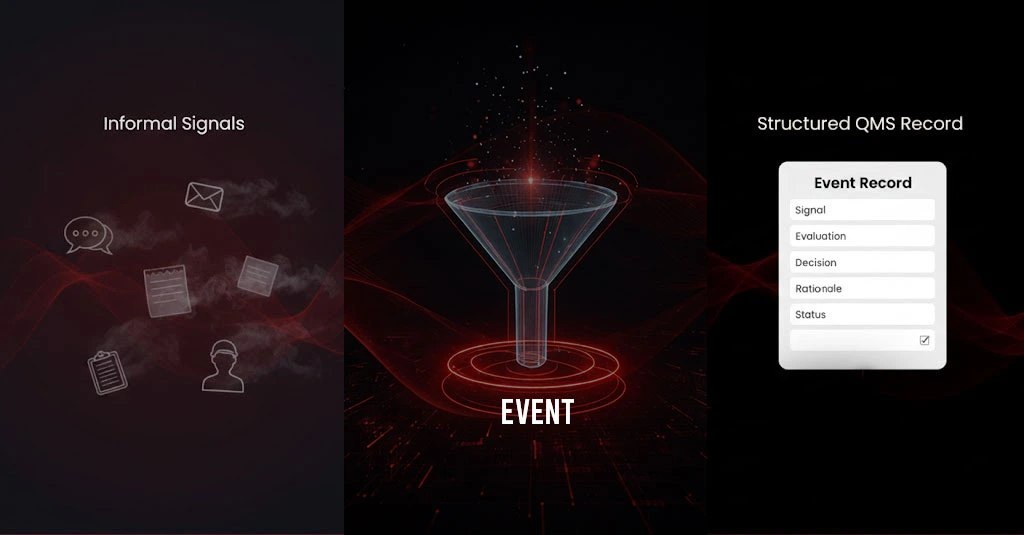
An Event is a controlled intake record that captures a quality signal at the moment it occurs.
It can start small, but it becomes documented reality inside the QMS.
An Event typically includes:
- what happened (signal)
- what type it appears to be (change, deviation, feedback, audit finding)
- initial impact / relevance
- triage decision (close / task / escalate)
- documented rationale
- ownership and status
- timestamps and audit trail
This is “informal → structured” in one step.
Why every Event should NOT become a CAPA
One of the biggest operational failures in quality systems is over-escalation:
When everything becomes CAPA, nothing gets resolved efficiently.
A proper QMS needs triage:
- Some signals are minor and can be closed with rationale.
- Some require a simple corrective task.
- Some must escalate into CAPA or Change Control.
Quality Event System makes that possible without losing the signal.
Event first. Decision second. Escalation only when justified.
A realistic example
A field engineer notes minor sensor drift during routine checks.
Old world:
- a chat message, maybe an email, maybe a task
- no documented evaluation
- no traceable decision rationale
Event-driven world:
- the engineer logs an Event
- the QMS Manager reviews and records a decision
- if it’s insignificant: close with rationale
- if it’s significant: escalate to deviation, CAPA, or Change Control
- outcome becomes auditable evidence
This is exactly the kind of scenario that creates audit findings when it stays informal.
Capturing the signal is only the first step.
The real challenge is keeping everything connected.
→ See how traceability fails when a requirement changes
What a Quality Event System (QES) actually gives a QMS Manager
Not “more logging.”
More defensibility with less effort.
A Quality Event System gives you:
- visibility into signals before they become crises
- documented triage (no more “we discussed it” without evidence)
- proportional escalation (less CAPA overload)
- team participation (engineers can log, QA controls the decision)
- audit-ready chronology (what happened → what was decided → what was done)
Micro-glossary (for consistent terminology)
Task: execution output, often created after an Event is reviewed
Event: the documented starting point of a quality signal
QES (Quality Event System): the capture + triage layer where Events are evaluated before escalation
The qmsWrapper Logic
Capture → Structure → Retrieve → Defend
- QES (Capture): Every quality signal becomes a documented Event.
- DTF (Structure): Every requirement, risk, and test remains connected through the lifecycle.
- AI Search (Retrieve): Every decision and link can be retrieved instantly, across modules.
Result: Structured, defensible compliance — not reactive documentation.
Terminology Clarified
- Event: A documented starting point of a quality signal before escalation.
- QES: The controlled intake and triage layer of your QMS.
- DTF: The structured design control environment that keeps traceability intact.
- AI Search: Semantic retrieval across quality, design, risk, and evidence.
What Comes Next
First, we made it possible to capture every signal.
Then, to keep it structurally connected.
Soon, we will show how structured events can be intelligently mapped into controlled execution — always with human approval at critical decisions.
FAQ: AI-Powered QMS for MedTech
Is an Event the same as a deviation?
No. An Event is the intake record. It may be classified as a deviation after review, or closed with rationale if not significant.
Why not just create a task?
Because tasks don’t capture the evaluation and decision logic auditors expect. Events preserve the compliance story.
Does Quality Event System replace CAPA?
No. Quality Event System prevents CAPA overload by capturing signals early and escalating only when justified.
What’s the benefit for ISO 13485 audits?
Events create traceable evidence of evaluation and decision-making—especially for signals that would otherwise remain informal.
Capture first. Connect next. Mapping is coming.